
When homeowners think about outdoor lighting, the front walkway usually comes to mind first.
Maybe a few lights along the path. Something near the front door. A fixture pointing at a favorite tree.
Done, right?
Not quite.
A thoughtful landscape lighting design looks at how the entire property works after sunset. Where do people walk? Where does the grade change? Which parts of the landscape disappear completely? Where do people gather? Which architectural or landscape features deserve attention once daylight is gone?
Good outdoor lighting isn’t about putting a fixture everywhere.
It’s about putting the right light in the right places.
For homeowners considering landscape lighting in Dayton, Ohio, Cable Bros Outdoor Living & Landscaping designs low-voltage lighting around the property, its features, and how the outdoor space is actually used after dark. Cable Bros’ lighting options include path lighting, uplighting, downlighting or moonlighting, accent lighting, step and deck lighting, underwater lighting, and string lights.
So where should landscape lighting go?
Here are seven areas homeowners often overlook.
Why Landscape Lighting Placement Matters More Than Fixture Count
More lights don’t automatically create a better outdoor space.
In fact, putting too much light everywhere can flatten the landscape. Trees, architecture, pathways, and patios can lose the contrast that makes nighttime lighting interesting in the first place.
Think about a living room.
You probably wouldn’t illuminate every wall, chair, table, and corner at exactly the same brightness. You might have a lamp near the sofa, softer ambient light overhead, and accent lighting around artwork.
Landscape lighting works in a similar way.
Different areas have different jobs:
- Pathway lighting helps define where people are walking.
- Spot lights direct a narrower beam toward specific features.
- Flood lights spread light across a wider area.
- Up lights illuminate trees, architectural details, and plantings from below.
- Downlights can create softer pools of illumination from above.
- String lights add atmosphere around patios and pergolas.
- Step lighting helps define elevation changes.
The goal is layering.
Some areas need functional illumination. Others need a subtle glow. A few deserve to become focal points.
That makes placement more important than simply asking, “How many landscape lights do I need?”
7 Areas Homeowners Often Forget to Light
1. The Walk Between the Driveway and Front Door
The front sidewalk may have pathway lights, but what about the actual route guests take?
Sometimes the driveway connects cleanly to the front walk.
Sometimes it doesn’t.
Guests may step from the driveway onto a side section of walkway, cross part of the landscaping, or approach a set of steps before reaching the main path.
This transition area is easy to overlook during landscape lighting design because homeowners already think of the “front walkway” as covered.
Pathway lights can help create a visual route from parking to the entrance without making the approach feel overly bright. Cable Bros describes path lighting as soft downward illumination intended to define walkways and driveways while minimizing glare.
The important question is not simply:
“Is the walkway lit?”
It’s:
“Can someone clearly understand where to go from the moment they get out of the car?”
2. Side Yards, Gates, and Connecting Paths
The front and backyard get most of the attention.
The side yard gets forgotten.
Yet this may be the route between the driveway and patio, the location of a gate, the path to the backyard, or an area family members regularly cross after sunset.
A side-yard path can feel surprisingly dark because the house itself may block light coming from other areas.
These connecting spaces are good candidates for restrained pathway lighting or carefully positioned downlighting.
The goal doesn’t have to be dramatic.
Sometimes landscape lighting is doing its job perfectly when nobody notices the fixtures at all—they simply know where they’re going.
3. Steps and Changes in Elevation
A beautiful multi-level outdoor space can become difficult to read at night.
One step between patio levels may seem obvious at 3 p.m.
At 9 p.m.? Not necessarily.
This becomes especially important around:
- Patio steps
- Deck stairs
- Retaining-wall transitions
- Raised seating areas
- Front entrances
- Walkways on sloped properties
- Changes between hardscape and lawn
Cable Bros uses step and deck lighting that can be integrated into risers, walls, or deck areas to make elevation changes more visible without depending on a large fixture shining across the space.
When planning professionally installed paver patios, lighting is also worth considering alongside steps, seating walls, walkways, and other transitions. Cable Bros’ paver projects can include multiple levels, steps, and pathways, all of which affect how people move through an outdoor space.
A patio isn’t only viewed from the house.
People have to move through it.
Lighting should help make that movement feel natural after dark.
4. The Edges of Patios and Outdoor Living Areas
Homeowners often think about lighting the middle of the patio.
The edges can matter just as much.
Where does the paver surface end and the lawn begin?
Is there a landscape bed immediately beyond the seating area?
Does a walkway leave the patio and disappear into another part of the yard?
Are there seating walls or changes in grade nearby?
Strategic patio lighting can define the shape of the outdoor living space without flooding the entire surface with light.
This is also where downlighting can be especially effective.
Mounted above, downlights can cast softer pools of light across seating areas or garden beds. When positioned through tree canopies, this technique is often called moonlighting because the pattern can resemble natural light filtering through branches.
Cable Bros specifically uses this approach around patios, seating areas, and water features.
The result can make an outdoor room feel usable without making it feel like someone turned on stadium lights.
5. Trees, Columns, Stonework, and Architectural Details
You’ve spent years growing that tree.
Or invested in stonework around the house.
Then the sun sets and it disappears.
Landscape lighting can extend the visual life of those features well into the evening.
Uplighting works especially well for vertical elements because the light starts low and moves upward. Depending on placement and beam width, it can emphasize:
- Mature specimen trees
- Interesting branching structure
- Stone columns
- Chimneys
- Facade details
- Tall ornamental plantings
- Textured walls
Cable Bros uses uplighting to create depth and dimension around both trees and architecture.
Spot lights can serve a similar purpose when a more focused beam is needed.
The difference is worth understanding.
A flood light spreads illumination across a broader area. A spot light is more concentrated, making it useful when the goal is to draw attention to one tree, sculpture, planting, or architectural feature.
Neither one is automatically better.
They simply do different jobs.
6. Pergolas, Seating Areas, and Places Where People Actually Stay
Some outdoor lighting plans are excellent at helping people get somewhere.
Then they forget to illuminate the place where everyone wants to stay.
Think about where evenings actually happen:
- Around the dining table
- Under a pergola
- Near an outdoor kitchen
- Around a fire feature
- In a conversation area
- On a covered patio
- Around a lounge or seating wall
These areas benefit from lighting that feels comfortable rather than purely functional.
String lights can work especially well over patios and pergolas because they create a relaxed overhead layer instead of concentrating all the illumination near ground level.
Downlighting can also create softer light around seating areas.
Often, combining several subtle sources creates a more inviting space than relying on one very bright fixture.
The idea is simple:
You shouldn’t only be able to find the patio after dark.
You should still want to sit there.
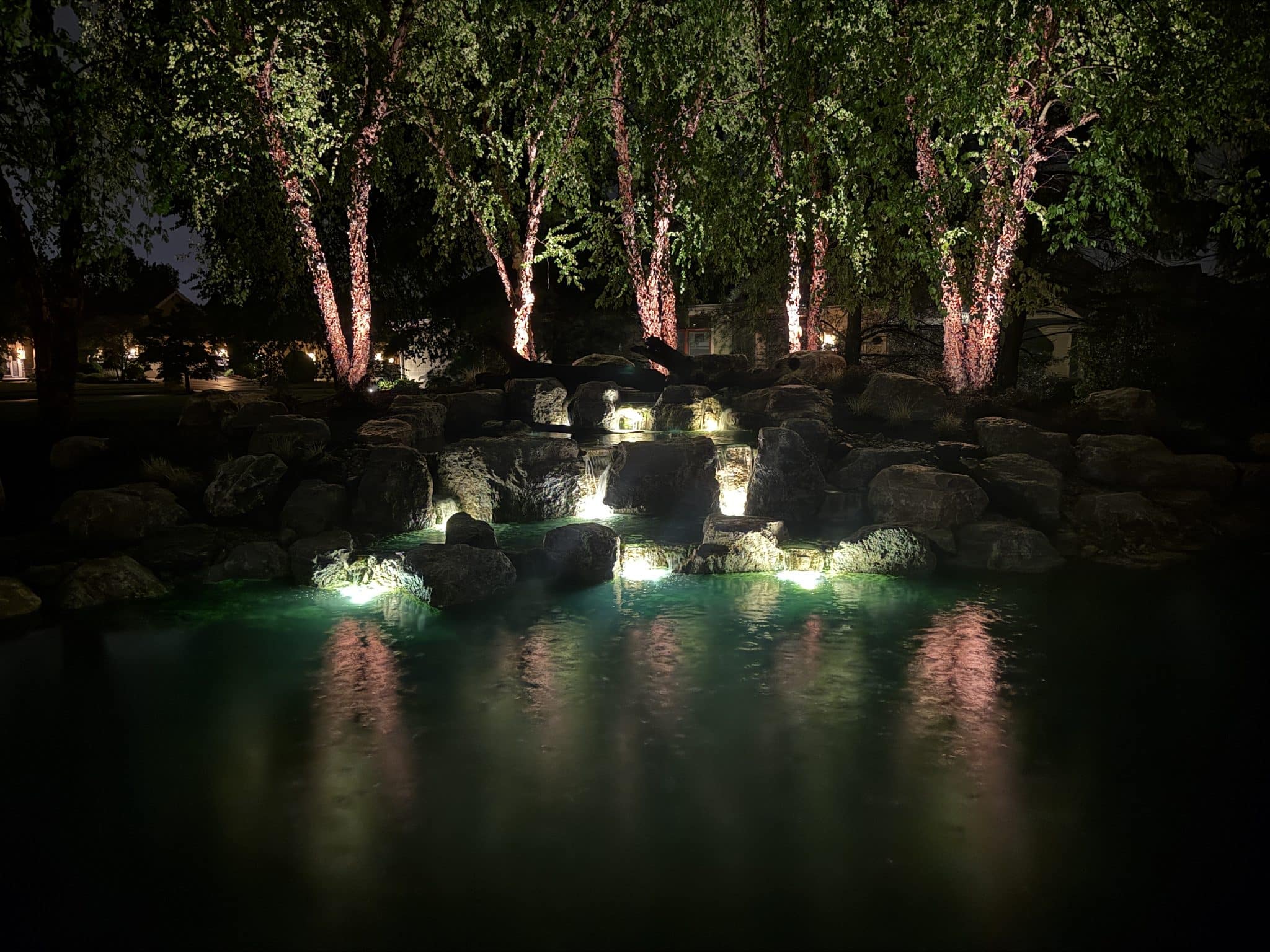
7. Water Features and Landscape Focal Points
A pond, fountain, waterfall, sculpture, or carefully designed planting bed can be one of the most interesting elements in the yard during the day.
At night, it can vanish completely.
Accent lighting helps bring those focal points back into view.
Cable Bros uses spotlights and other accent-lighting techniques around ornamental plantings, garden features, and water features. Low-voltage underwater fixtures can also illuminate waterfalls, rockwork, spillways, plants, and other elements from within the water itself.
This is where restraint matters.
The goal isn’t necessarily to make the brightest object in the backyard.
Sometimes a small amount of carefully aimed light is enough to reveal moving water, stone texture, or the silhouette of a plant.
A feature that looked great at noon can feel completely different at night.
That second experience is worth designing too.
Match the Lighting Technique to What You Want to See
Once the overlooked areas are identified, the next question becomes: what type of light belongs there?
A thoughtful landscape lighting design usually combines several techniques rather than repeating the same fixture throughout the property. Pathway lights can define walkways, uplighting can bring attention to trees and columns, and downlighting or string lights can create a softer atmosphere around patios and seating areas. Spot lights can highlight a garden focal point, while carefully placed flood lights can provide broader illumination where it is needed.
The goal is variety with purpose.
Imagine looking across the backyard at night. The pathway has a soft glow. A mature tree is illuminated from below. Gentle downlighting falls across the patio. String lights add warmth over the pergola. A waterfall catches just enough light to remain visible beyond the seating area.
Your eye naturally moves through the landscape.
That feels very different from making every part of the yard equally bright. Cable Bros also fine-tunes fixture angles and brightness during nighttime visits because outdoor lighting ultimately needs to be evaluated when it is actually being used: after dark.
LED Lighting and Astronomical Timers Make the System Easier to Live With
Placement gets most of the attention, but the technology controlling the system matters too.
Cable Bros focuses on low-voltage LED landscape lighting.
LEDs are well suited to outdoor lighting because of their efficiency and long service life. According to the U.S. Department of Energy, good-quality white LED products commonly have useful lifespans of roughly 30,000 to 50,000 hours or longer, compared with about 1,000 hours for a typical incandescent lamp.
DOE has also reported that LED bulbs can use roughly 75% less energy than traditional incandescent lighting while lasting substantially longer.
For a landscape lighting system, that can mean:
- Fewer lamp replacements
- Lower energy consumption
- Less routine maintenance
- More flexibility in fixture placement and beam characteristics
The controls matter too.
Cable Bros uses astronomical timers to manage when its low-voltage landscape lighting systems turn on and off.
Rather than relying on a motion sensor to activate the landscape lighting, astronomical timers can calculate changing dawn and dusk times and adjust schedules as daylight changes throughout the year. Intermatic, a manufacturer of astronomical controls, describes the technology as automatically compensating for seasonal changes in daylight and determining sunrise and sunset times.
That’s useful in Ohio.
Sunset in June looks nothing like sunset in December.
The lighting schedule can account for that seasonal shift without treating every evening of the year the same.
Plan the Lighting Around the Whole Outdoor Space
Landscape lighting works especially well when it isn’t treated as an afterthought.
If you’re planning a patio, walkway, landscape renovation, pergola, fire feature, or water feature, thinking about outdoor lighting as part of the larger project gives you an opportunity to consider how the property will function both during the day and at night.
Walk the space mentally.
A guest pulls into the driveway.
Where do they go?
They walk toward the backyard.
Can they see the path?
They step down onto the patio.
Is that transition clear?
Everyone gathers around the seating area.
Does the lighting feel comfortable?
Beyond them is a beautiful tree, garden bed, or water feature.
Can anyone see it?
This is why the question “Where should landscape lighting go?” rarely has a seven-fixture answer.
The right locations depend on the house, the landscape, how people move through it, and which areas deserve attention after sunset.
And sometimes the most important lighting location is the one you didn’t notice until the lights weren’t there.
See Your Property Differently After Sunset
Your landscape doesn’t stop existing when daylight ends.
The trees are still there.
The patio is still there.
The walkway, garden, retaining wall, water feature, and outdoor seating areas are all still part of your home.
A thoughtful landscape lighting design simply gives those spaces another life after dark.
For some homeowners, that means making pathways and steps easier to navigate. For others, it means finally seeing a beautiful landscape from inside the house at night. And for families who spend evenings outdoors, it can mean getting several more usable hours from the patio they already enjoy.
Cable Bros Outdoor Living & Landscaping designs and installs low-voltage landscape lighting throughout the Greater Dayton area with the property, architecture, and outdoor living spaces considered together.
If you’re wondering which parts of your property are disappearing after sunset, schedule a consultation with Cable Bros and take a look at what your landscape could become after dark.
Sometimes you don’t need more outdoor space.
You just need to be able to see the space you already have.
